Table of contents
Temple jewellery is handcrafted gold jewellery defined by deity motifs, traditional craft techniques, and high-purity gold. Originating in the Chola dynasty, it moved from temple deity adornment into South Indian bridal culture, where it remains the standard for Tamil Nadu weddings today. Pieces like kasu malai, manga malai, mathapatti and vanki are specific to this tradition, not interchangeable with general antique jewellery. This guide covers the history, key pieces, motifs, and how South Indian brides wear temple jewellery today.
What Is Temple Jewellery?
The defining characteristics are the motifs, the techniques, and the material. Motifs are always drawn from Hindu iconography and temple architecture: goddess Lakshmi, the peacock, the elephant, the lotus, the yali (a mythological guardian creature), and mango or paisley forms. The primary techniques are nakshi work (hand-engraved surface carving) and repoussé, where gold is worked from behind to create raised relief patterns. The base material is 22 karat gold, set with rubies, emeralds, and pearls.
What it is not: temple jewellery is not the same as antique jewellery. Antique jewellery refers to an oxidised finish and a heritage aesthetic that covers many motif styles. Temple jewellery is a specific sub-category within that world, distinguished by deity motifs and the craft methods behind them. A plain antique bangle and a Lakshmi kasu malai carry the same finish, but only one is temple jewellery. Explore our guide on antique jewellery to have a better understanding.
Where Did Temple Jewellery Come From?
The origin is well-documented. During the Chola dynasty's peak between the 9th and 13th centuries, skilled goldsmiths were commissioned to create jewellery for temple deity idols. These were not decorative accessories: they were sacred offerings, crafted with the same seriousness as temple architecture itself. The motifs on the jewellery mirrored what was carved into temple walls, which is why there is such a strong visual continuity between Chola-era stonework and traditional temple jewellery pieces today.
Over centuries, this jewellery moved from temple sanctuaries into the broader culture. Bharatanatyam dancers adopted it as costume for classical performances, and gradually it became a central part of South Indian bridal adornment. That path, from deity to dancer to bride, is why temple jewellery carries the symbolic weight it does. It is not designed to look religious. It simply is religious in origin, and that origin is part of what makes it meaningful at a wedding.
The Pandya dynasty and later the Vijayanagara kingdom further reinforced the tradition. By the time South Indian bridal jewellery took its current form, temple pieces were already the established standard, not a new fashion.
What Is Temple Jewellery Made Of?
The base is almost always 22 karat gold. Lower purity is used for imitation or costume pieces, but authentic temple jewellery in a fine jewellery context is made in 22K. The gold is not just structural: it provides the right malleability for nakshi engraving and repoussé work, which cannot be done to the same detail in harder alloys.
The gemstone palette is traditional and consistent: rubies for their deep red, emeralds for green contrast, and pearls for softness and a finish that catches light differently from faceted stones. These are not random choices. Rubies and emeralds appear in temple paintings and deity ornamentation across Tamil Nadu, so their presence in jewellery is a continuation of the same visual language. Diamonds are used in contemporary temple jewellery designs but are not part of the original craft tradition.
The surface treatment matters as well. Temple jewellery typically has an antique finish rather than a high-polish shine, because the oxidised surface brings out the depth of the carved motifs. A high-polish kasu malai and an antique-finished one are both gold, but the antique finish makes the Lakshmi engravings far more visible and striking.
The Key Pieces: What to Know Before You Buy
Kasu Malai (Coin Necklace)
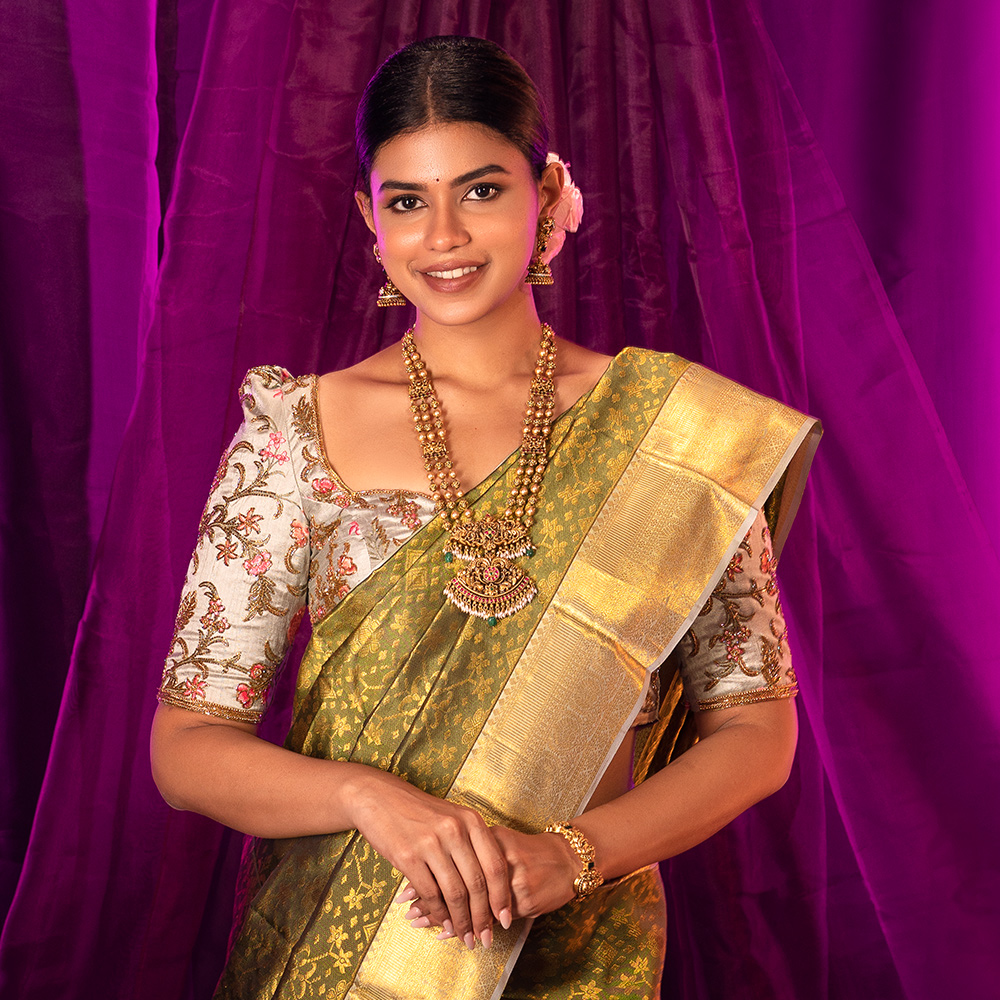
The kasu malai is the most recognised piece in temple jewellery. "Kasu" means coin in Tamil; "malai" means garland or necklace. It is exactly what the name says: a necklace of small gold coins, each engraved with the image of Goddess Lakshmi, strung together in an overlapping row. Longer versions form a haram (a chest-length garland); shorter versions sit at the collarbone as a choker.
The Lakshmi motif is not decorative here. Lakshmi is the goddess of wealth and prosperity, and wearing her image at a wedding is an auspicious act. Kasu malai is one of the most commonly requested pieces for a South Indian muhurtham because of this symbolism, and because it photographs exceptionally well against a Kanjivaram silk saree.
For weddings, brides typically choose a full-length kasu malai haram for the main ceremony and may opt for a shorter version for reception or pre-wedding functions. The piece is also available in a stacked or double-layer format for a more dramatic bridal look.

Manga Malai (Mango Necklace)
The manga malai takes its name from the mango motif ("manga" in Tamil), which in South Indian symbolism represents fertility, abundance, and auspiciousness. The necklace is made of linked mango-shaped elements in gold, often set with rubies and emeralds using the kundala-velai setting technique, where stones are set flush within the gold frame rather than raised above it.
The manga malai is heavier and more structured than a kasu malai. Where the kasu malai has a flowing, layered quality, the manga malai tends to have a more solid, architectural presence. Both are bridal staples, and many Tamil Nadu brides wear one of each, layering a kasu malai haram over a manga malai choker, or vice versa.
Lakshmi Haar
The Lakshmi haar is a longer necklace, distinct from the kasu malai in that its focal point is a central pendant rather than a uniform chain of coins. The pendant typically shows Goddess Lakshmi seated on a lotus, flanked by elephants or peacocks, set with rubies, emeralds, and sometimes pearls. The chain itself may incorporate smaller Lakshmi coin motifs or gold beads.
This is a versatile piece within temple jewellery: substantial enough for the main wedding ceremony but manageable enough to wear again at subsequent festive occasions.

Temple Jhumkas
Jhumkas are bell-shaped earrings, and the temple jhumka is specifically the version decorated with deity motifs, peacock designs, and lotus patterns, which you can read more about in our earrings guide . They are among the most wearable temple jewellery pieces for everyday festive use precisely because they do not require the full commitment of a grand necklace to make an impact. A pair of temple jhumkas with a silk saree at a family function is a complete traditional look.
For bridal use, larger jhumkas with chandelier extensions or layered drops are standard. Some designs incorporate a chain from the earring to a hair clip (a style sometimes called a maatal), which keeps heavy earrings stable and adds visual drama.
Mathapatti (Bridal Headpiece)
The mathapatti is a headpiece that sits along the centre parting of the hair and extends across the forehead. It is made up of linked gold plaques, usually with Lakshmi or floral motifs, often set with rubies and pearls. In a traditional Tamil Brahmin bridal look, the mathapatti is one of the defining pieces alongside the kasu malai and manga malai.
It is worth noting that the mathapatti is worn on the hair itself, not the forehead. It does not sit on the skin the way a maang tikka does. This distinction matters when ordering a custom piece, because the sizing needs to account for hair volume.
Vanki (Armlet)
The vanki is a temple armlet worn on the upper arm. It is one of the oldest documented pieces in South Indian jewellery: armlets of this design appear in Chola-era sculptures. For brides, the vanki typically features a central Lakshmi motif with wing-like extensions on either side, set with rubies and emeralds. It is worn on both arms as part of a full bridal set.
Oddiyanam / Vaddanam (Waist Belt)
The oddiyanam is a waist belt in gold, worn over a saree or lehenga. It is among the most ceremonially significant pieces in a South Indian bridal set and historically was considered a mark of a bride's family wealth. The centrepiece usually features Goddess Lakshmi or a large floral panel, with the belt extending outward in linked gold plaques. Rubies and emeralds appear throughout.
Not every bride opts for a vaddanam, particularly for smaller weddings or reception events, but it remains standard for grand Tamil Nadu muhurtham ceremonies.
How South Indian Brides Wear Temple Jewellery Today
The full traditional bridal temple set includes a mathapatti, a kasu malai or manga malai haram, a Lakshmi haar or shorter necklace, temple jhumkas, a vanki on each arm, and an oddiyanam. This is the classic head-to-waist bridal look for a Tamil wedding ceremony.
In practice, brides make choices based on their wedding format and personal preference. A bride at an intimate court wedding might choose two or three key pieces rather than the full set. A bride at a large traditional muhurtham typically wears most or all of the pieces listed above. The question is not which pieces are "authentic" but which combination works for the occasion and the outfit.
One practical note: temple jewellery is designed to complement Kanjivaram and other South Indian silk sarees specifically. The weight, scale, and colour palette of these pieces are calibrated for richly woven silk, not lightweight fabrics. Brides wearing chiffon or lighter contemporary drapes should consider a more restrained selection of temple pieces rather than the full ceremonial layered look.
For pre-wedding functions like a valaikapu or seemantham, lighter temple pieces work better: a Lakshmi haar with small jhumkas rather than the full haram-plus-vaddanam combination.

Motifs and What They Mean
The motifs on temple jewellery are not arbitrary decoration. The peacock represents divine protection and beauty; it appears throughout Hindu iconography and is also the national bird, which has reinforced its presence in South Indian jewellery design across centuries. The elephant, associated with Ganesha, signals auspiciousness and the removal of obstacles, making it an obvious choice for wedding jewellery. The lotus represents purity. The yali, a guardian creature that is part lion and part elephant, appears on temple structures as a protective symbol and carries the same protective symbolism in jewellery. The mango motif, which forms the manga malai, is specifically associated with fertility and abundance in Tamil culture.
Understanding these meanings is useful not just culturally but practically: it helps brides make intentional choices rather than purely aesthetic ones.
What to Look for When Buying
Authentic temple jewellery in fine gold should come with BIS hallmarking, which certifies the gold purity. At Goutham Jewellers, all gold pieces carry BIS hallmarking as standard. For the gemstones, particularly rubies and emeralds, ask about the quality and origin. In traditional temple jewellery, kemp stones (glass-set in gold foil, not precious rubies) are sometimes used in imitation or semi-fine pieces. Fine jewellery pieces use genuine rubies and emeralds.
Workmanship is visible. Nakshi engraving should be sharp and consistent; repoussé relief should have depth and clarity. On a well-made kasu malai, the Lakshmi figure on each coin should be recognisable and detailed, not blurred or indistinct. The links connecting each motif element should move smoothly without catching or stiffening.
Customisation is available for most temple jewellery types at Goutham Jewellers, including sizing for vaddanam, adjustments to mathapatti length, and specific motif preferences for key pieces. Lead times vary depending on the complexity of the piece, so for bridal orders, plan well in advance of the wedding date.