Table of contents
Jump to
- 1Quick Guide: Polki Vs Kundan
- 2Introduction
- 3What Is Polki Jewellery?
- 4What Is Kundan Jewellery?
- 5Where Jadau Fits In
- 6Difference Between Polki and Kundan Jewellery
- 7Beyond the Basics: Four More Differences Worth Knowing
- 8How To Differentiate Between Polki and Kundan Jewellery
- 9Which Jewellery Should You Choose?
- 10Final Thoughts
The biggest difference between Polki and Kundan jewellery is the material. Polki uses natural uncut diamonds, while Kundan uses glass or gemstones set using refined gold foil. As a result, Polki is generally more expensive, has better resale value and is considered an heirloom investment, while Kundan offers a similar traditional appearance at a more accessible price. Whether you're choosing jewellery for your wedding, building an heirloom collection or simply trying to understand the difference, this guide explains how Polki, Kundan and Jadau compare so you can make a confident decision.
Quick Guide: Polki Vs Kundan

Introduction
Polki and kundan get grouped together constantly and for good reason. Both belong to India's bridal jewellery tradition, both show up in the same trousseau and at a quick glance they can look similar under wedding lighting. But the difference between polki and kundan jewellery comes down to what's actually in the piece, how it's made and what that means for cost and longevity.
Polki is built from uncut natural diamonds, which gives it a softer, more restrained sparkle. Kundan is built from glass,gemstones or coloured stones set in gold foil, known for sharper shine and detailed handwork. Customers walking into our Saidapet showroom usually aren't choosing one over the other in the abstract. They're choosing based on what function they're dressing for, what their saree or lehenga calls for and what they're willing to spend.
What Is Polki Jewellery?
Polki jewellery uses diamonds in their natural, uncut state. No faceting, no polishing for maximum brilliance. That's deliberate. The raw texture is the point. It's what gives polki its quiet, almost antique glow rather than the sharp sparkle you'd get from a cut stone.
The style has royal Indian roots and still holds its place as one of the most requested bridal categories we see. Necklaces, chokers, and full sets in polki tend to go to brides who want something that reads as heirloom rather than trend.
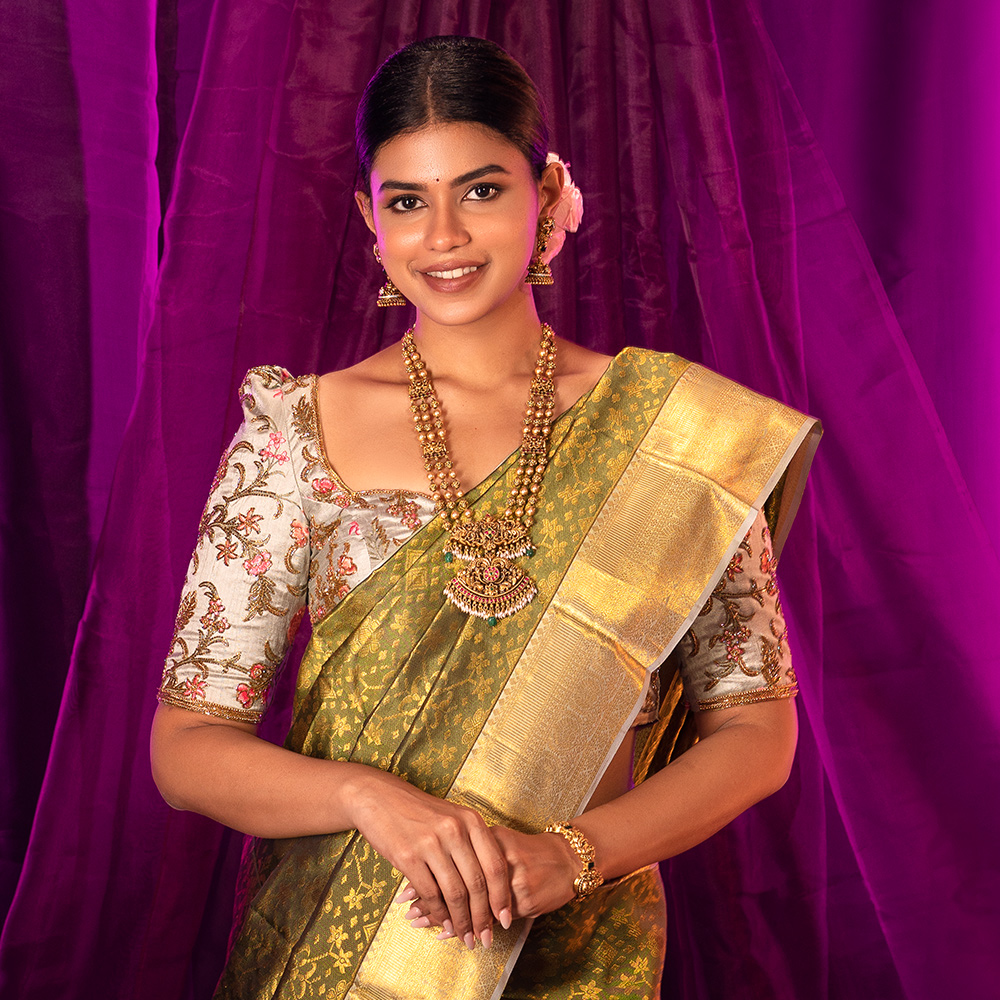
In Chennai, we see polki worn differently than how it's typically styled up north. It's less often the only jewellery in the look. Brides frequently pair a polki choker or earrings with their family's antique gold or temple jewellery pieces rather than replacing them, especially for the muhurtham itself. Against a Kanjivaram silk, polki's softer glow holds its own without competing with the saree's zari work the way a brighter stone might.
For a closer look at polki specifically, read our detailed guide to polki jewellery. You can also browse our polki jewellery collection.

What Is Kundan Jewellery?
Kundan is a setting technique, not a stone. Coloured glass or gemstones are placed into a frame and held with layers of refined gold foil, a method that goes back to the Mughal courts and is still closely tied to Rajasthani craftsmanship.
What you'll usually notice first is the detailing. Many kundan pieces carry meenakari enamel work on the reverse, so the piece is doing two jobs at once: visible brilliance on the front, colour and craft on the back. Kundan tends to read brighter and more decorative than polki, which is part of why it shows up across weddings, festive wear, and family functions, not just bridal day looks.
If you want the full breakdown of how kundan is made and what separates it from polki and Jadau, we've covered that in depth in our guide on what kundan jewellery is.
Locally, kundan has become the practical choice for the functions around a Tamil wedding rather than the muhurtham itself: sangeet, reception, the engagement. It's light enough to wear through a long evening, and its brighter shine suits the pastel and jewel-tone lehengas that have become common at Chennai pre-wedding events, even in households where the bridal saree itself stays traditional South Indian silk.

Where Jadau Fits In
If you've spent any time looking into bridal jewellery, you've probably seen "Jadau" used alongside both polki and kundan, and it's a fair source of confusion. Jadau isn't a third material or a competing style. It's the umbrella hand-setting technique both polki and kundan fall under, where stones are set into gold without soldering, by hand, using traditional tools.
So when a piece is described as Jadau polki or Jadau kundan, it's telling you about the setting method, not introducing a separate category. Most fine jewellers, us included, use Jadau as the foundation technique, then build either a polki or kundan piece on top of it depending on the stones used.
Difference Between Polki and Kundan Jewellery
What's the biggest material difference?
Polki uses natural uncut diamonds. Kundan uses glass or coloured stones set in gold foil. That one distinction is what drives almost every other difference on this page: price, resale, durability, and how each catches light.
Appearance and shine
Polki has a soft, almost antique glow because the diamonds are left uncut. It photographs well in low light and tends to suit brides going for an understated, regal look rather than maximum sparkle.
Kundan throws back more light. It's brighter under flash photography and stage lighting, which is part of why it pairs so well with colourful outfits and festive settings where you want the jewellery to be seen across a room.
Craftsmanship
Polki is set using the Jadau technique by hand, with no glue and no machine setting. Kundan setting also uses hand-applied gold foil, often finished with meenakari enamel on the back. Both are slow, skilled work; the difference is in what's being set and how it's finished.
Price
Polki costs more, because it's made with real diamonds and substantial gold. It's the category families tend to treat as an investment piece rather than a one-occasion purchase.
Kundan spans a much wider price range, from lightweight festive pieces to elaborate 22k gold bridal sets, which is part of why it works for buyers who want the traditional look without polki's price ceiling.
Resale value
Polki is generally regarded as the stronger resale option, since it's priced on diamond and gold content that holds value independently of the piece itself. Kundan's value sits more in the craftsmanship and design than the raw material. Well-made kundan still holds worth, but it isn't priced the same way polki is. If resale matters to your decision, it's worth asking us directly about a specific piece rather than assuming either category behaves the same way across the board.
Weight and comfort
Polki runs heavier. Diamonds and solid gold settings add up. Brides often don't mind this for the wedding day itself, when the weight is part of the occasion.
Kundan is usually lighter, which makes it the more comfortable option for functions that run long: sangeet, mehendi, multi-day wedding schedules where you're wearing jewellery for hours at a stretch.
Durability and upkeep
Polki holds up well over decades with basic care, which is why so many families keep it as a passed-down piece. Traditional polki, kundan, and Jadau pieces are actually exempt from India's mandatory BIS hallmarking rules, since they're handcrafted using older techniques the standard testing process wasn't built around. At Goutham Jewellers, we hallmark our polki pieces anyway, as a voluntary step, so the gold content is verified regardless of how the piece is later valued.
Kundan needs a bit more attention. The gold foil and stone settings are more delicate, and moisture or rough handling will show over time. Proper storage extends its life considerably.
Beyond the Basics: Four More Differences Worth Knowing
Where the names come from
The two words aren't naming the same kind of thing, which is part of why people mix them up. "Polki" comes from the Hindi word for an uncut diamond, so the name points straight at the stone. "Kundan" comes from a Hindi word for highly refined, pure gold, so the name points at the metal, not the stone sitting inside it. That's also why a kundan piece can use almost any coloured stone and still be called kundan: the term was always about the gold-foil setting, not what's set into it.
Where they come from: origin and history
Both styles trace back to the Mughal era, but they didn't stay equally exclusive. Kundan started in the royal courts of Rajasthan and Gujarat, and over time the technique spread outward. Artisans in Rajasthan, Bihar, and Punjab began recreating court kundan in silver and lighter gold for ordinary buyers, which is why kundan became widely affordable long before polki ever could.
Polki couldn't follow the same path, because it depends on real uncut diamonds rather than glass or gemstones. There was no equivalent "budget version" to copy, so polki stayed tied to royal and wealthy households, including Rajput nobility and affluent trading families, for far longer. That difference in how each style was adopted is part of why kundan still spans such a wide price range today, while polki has stayed at the premium end almost by definition.
Quality grading: why polki has tiers and kundan doesn't
Because polki uses real uncut diamonds, the stones themselves get graded the way diamonds do elsewhere, just less formally. In the trade, polki diamonds are typically sorted into three rough quality bands: a top grade prized for its clarity and brilliance, a mid-range grade, and a lower grade that's usually treated to improve how it looks before it's set. Two polki pieces that look similar from across a room can sit in very different quality bands depending on which grade went into them.
Kundan doesn't really have an equivalent system, because the stones are glass or semi-precious material rather than natural diamonds. What varies in kundan is the quality of the gold foil and the precision of the setting work, not a graded stone underneath. This is one more reason a straight price comparison between the two doesn't tell the whole story. Within polki alone, the diamond grade can move the price as much as choosing polki over kundan does.
Certification: what's actually checked for each
Polki and kundan get certified differently, and it's worth knowing before you buy either. Because polki contains real diamonds, it's reasonable to ask for diamond certification (commonly IGI or GIA) alongside gold purity certification. Kundan, since it's set with glass or semi-precious stones rather than diamonds, doesn't carry diamond certification in the same way; what you'd typically see instead is gold purity certification alone, covering the foil and framework rather than the stones themselves.
This connects back to the hallmarking exemption mentioned earlier. Since both categories fall outside mandatory hallmarking, the certification you're shown for either one is something the jeweller has chosen to provide, not something the law requires for these specific styles. That's worth asking about directly rather than assuming it's automatically included. If you'd like to see how this plays out on a specific piece, our polki jewellery collection is a good place to start the conversation.
How To Differentiate Between Polki and Kundan Jewellery
- Polki uses uncut natural diamonds with a soft, low-key shine
- Kundan uses glass or coloured stones with a brighter, sharper shine
- Polki is noticeably heavier in the hand
- Kundan tends to look more colourful and decorative
- Polki has an antique, restrained finish
- Kundan often features meenakari work on the reverse

Which Jewellery Should You Choose?
This is really the question most people land on this page to answer, so here's a straight way to think about it.
If you're buying one statement piece for the wedding day itself, the reception, the main ceremony, and you want something that holds value and gets passed down, polki is the better fit. It's the higher upfront cost, but it's also the one piece that's still relevant (and valuable) twenty years from now.
If you're dressing for multiple functions, sangeet, haldi, the reception, plus whatever comes after the wedding, kundan stretches further. You can put together two or three kundan pieces for what one polki set might cost, and you won't be wearing the same heavy set throughout every event.
If the budget is tight and you still want the traditional bridal look, kundan gets you there without compromising on craftsmanship. Plenty of brides mix both: polki for the main event, kundan for everything around it.
You don't have to pick one or the other for a single piece, either. Some sets combine polki and kundan in the same design, often with pearls or coloured enamel work alongside the uncut diamonds. It's a way to get polki's heirloom value and kundan's colour and detail without buying two separate pieces. You'll find a few of these hybrid styles in our wedding jewellery collection.
None of this is one-size-fits-all. Outfit colour, family pieces you're already inheriting, and what you're pairing it with all change the answer. We've also noticed a real shift in the last few years: even brides set on a traditional South Indian wedding are increasingly choosing lighter polki or kundan pieces for the events outside the muhurtham, saving the heavier temple and antique gold sets for the main ceremony alone. That's a conversation worth having in person or over a quick call rather than guessing from a screen.
Final Thoughts
Polki and kundan aren't competing for the same job. Polki is the investment piece: fewer pieces, higher cost, built to outlast the wedding by decades. Kundan is the versatile option: lighter, more colourful, and priced to work across multiple events without strain.
Have a specific outfit or budget in mind? Message us on WhatsApp and we'll help you figure out which one actually fits the occasion with an online consultation. Or visit our Saidapet showroom to see both side by side; photos never quite capture the difference in person.